Hello, dear friends. I hear over and over again about how people desperately want to make a change in their lives, but have no idea why they can’t make it happen.
Of course, there’s a constellation of reasons that might be contributing to each person’s individual situation, however, something called “negativity bias” is often present when we can’t seem to accomplish what we’ve set out to do.
Negativity bias is our unconscious tendency to focus on unpleasant things, and simultaneously dismiss the positive ones.

Have you ever had an objectively nice day, only to have one rude comment from someone completely subsume your psyche? Have you ever found yourself sitting on the couch thinking about your goal to exercise, or read more, or quit smoking weed, or some such other thing… and the more you think about your goals, the more you stay glued to the couch? Have you ever gone out for a run, or picked up a wrench to fix your own car, and immediately had a persistent thought of “I should stop doing this. Who do I think I am, trying to run, or fix my own car, or change my life, or learn something new?” Is the draw of self-soothing behaviors and habits much stronger than the draw of your life-affirming goals?
Enter in: negativity bias. It is a natural tendency of the human brain to brush past the positive and focus on the negative. If you’re thinking, “Well. That’s inconvenient.” I’m with you. What exactly is the point of having our brains naturally focus on negativity? Well, back in the day, when human’s daily lot was a physical struggle for mere survival — we had to focus on what might kill us in order to survive. Our negativity bias was an important survival mechanism that alerted us to things like being socially rejected from our group (humans only survived because of our strength in numbers, and being cast out meant certain death), or to tell us not to waste energy on new pursuits when we already had a system for what was keeping us alive.
Studies have shown that negative stimuli cause a stronger reaction in our brains than positive stimuli. It’s not your fault that you’re focused on what you could lose if you make a change, or if you feel glued to the couch when all you want to do is start that new exercise routine like you’ve been promising yourself you’d do for months.
Well, this is depressing. How exactly do we overcome negativity bias and work towards achieving our goals? The first step is to acknowledge that this is what you’re experiencing. If you’ve run 10 steps and your brain says to stop — you can say “I know to expect resistance.” This acknowledgement helps unblend us from that ancient part of our brain and create new neural pathways that can help us form new habits. As soon as you start to shine light on the situation, and realize you don’t have to believe everything that you think — you can begin to break free. A crack has formed in the armor.
After knowing to expect resistance, you can then create a tiny goal. Make the goal absolutely, positively, undeniably achievable. If you want to eat healthier, your goal can be to eat one carrot this week. Then when you eat that fkn carrot, celebrate. Relish. Force a smile, literally pat yourself on the back, jump around and dance and be grateful and focused on how amazing it is that you did the hardest part — the first tiny step. Don’t forget to expect resistance during your celebration. Invite that feller to celebrate with you! New neural pathways and thus new habits are based on focus, repetition, and growth — but we can’t get there if we don’t start.
When negativity bias pops up, again and again, you can greet that silly feller with a smile. Separate from it with your acknowledgement to expect resistance. Then, spend time concentrating on your inevitable success with your highly achievable tiny goals. In time, your brain will naturally re-focus itself on gratitude and growth, and let go of the persistent negative strength that used to rule your life.
May you be happy and free, dear reader.
Announcements and such:
If you enjoy this writing and want to support this work, please share it with a friend, or you can subscribe to this Substack for $8/month. Donations to our nonprofit can be made in any amount via our website, https://www.recoverydemystified.com/donations/
If you want help applying these skills to your own life, I’m now offering sliding scale 1:1 Recovery Coaching services. Click here for more information and to schedule a free 20 minute Sweet Freedom Strategy Call.
This week on the podcast we hear from Pepe Bandit. He talks about the gray area of process addictions, and tells his truly wild story of buying an airplane to traffic weed. Click here to listen.
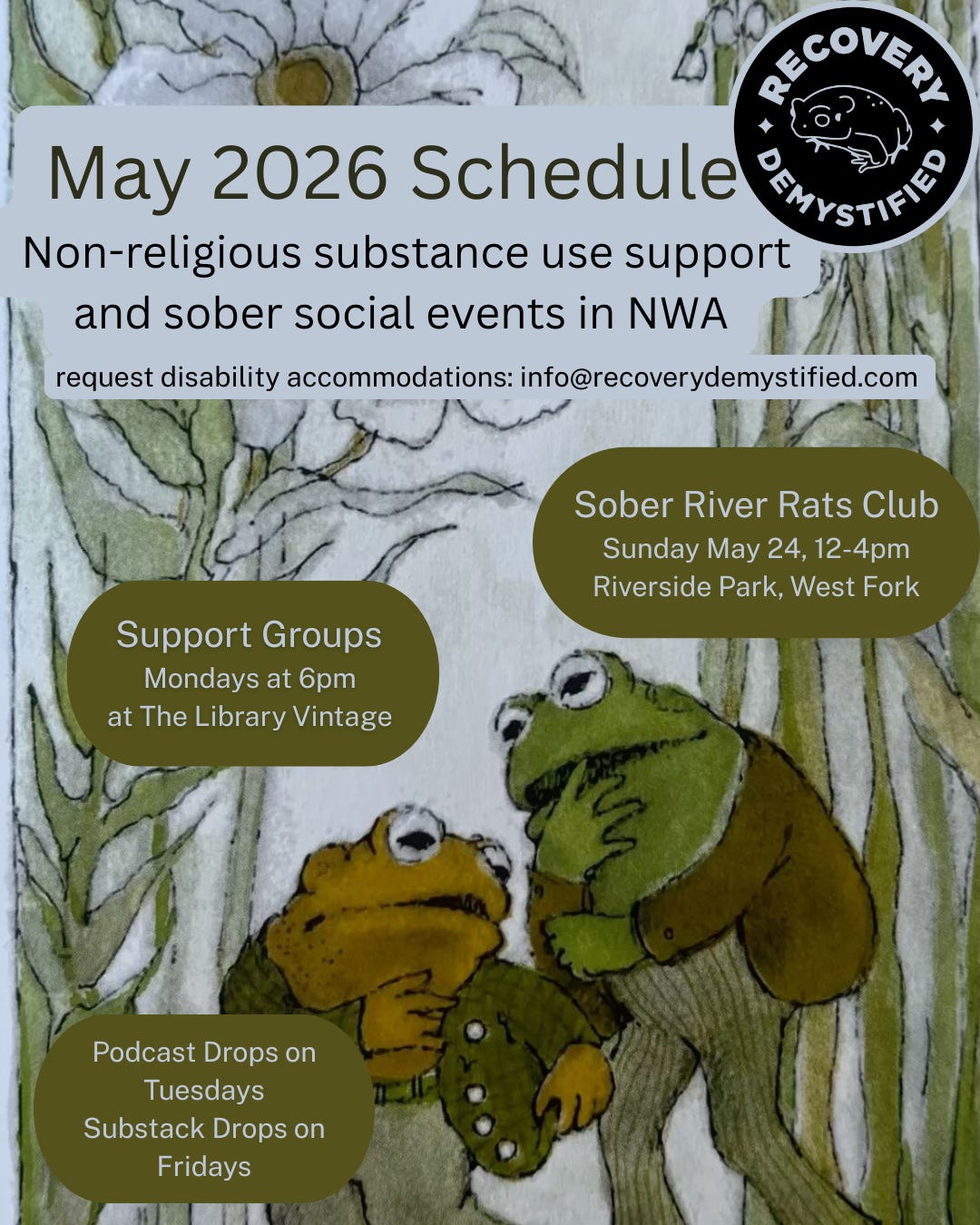
Support groups are still every Monday at 6pm at The Library Vintage in Fayetteville, AR.